Transcript
Announcer:
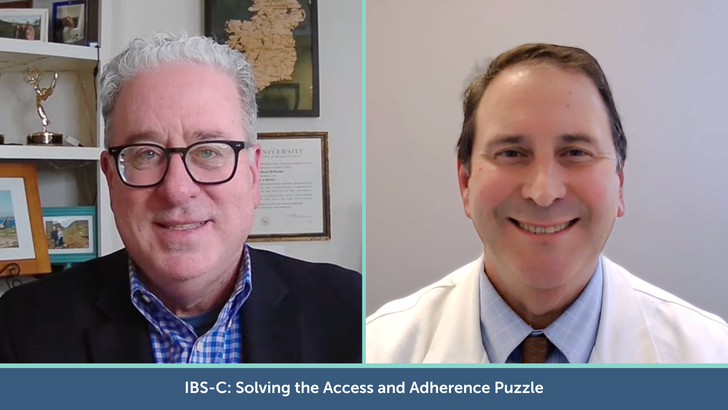
You’re listening to GI Insights on ReachMD, and this episode is sponsored by Ardelyx. Here’s your host, Dr. Brian McDonough.
Dr. McDonough:
Welcome to GI Insights on ReachMD. I'm Dr. Brian McDonough, and joining me to share strategies for improving treatment access and adherence in irritable bowel syndrome with constipation, or IBS-C for short, is Dr. Brooks Cash. He is a Professor of Medicine at Texas A&M. He also serves as the Medical Director of the Functional Bowel Center at Baylor University Medical Center. Dr. Cash, it's great to have you here today.
Dr. Cash:
Thanks, Dr. McDonough. It's great to be here.
Dr. McDonough:
Well, Dr. Cash, let's just dive right in. When you're ready to escalate therapy for a patient with IBS-C, where do you most commonly see the process breakdown between clinical decision and treatment initiation?
Dr. Cash:
That's a great question. There's a number of different places that the whole process can break down. But really, the first place is when we order the next medication and we have to do a prior authorization, typically with insurance, to get it covered by insurance. A lot of these therapies are not covered.
The diagnostic process or the diagnosis that we give when we do those prior authorizations is particularly important, whether a therapy is approved by the FDA for irritable bowel syndrome with constipation or perhaps if it's approved for chronic idiopathic constipation. And I would stress to the audience that the differences between those two diagnoses are is very semantic.
So chronic idiopathic constipation is constipation—which is difficult defecation—and there's a number of different symptoms that go along with that without abdominal pain at its center, whereas irritable bowel syndrome is centered around abdominal pain or discomfort. And then when it's IBS-C, of course, it's the same symptoms as chronic constipation.
So I often will give both diagnoses so that I can use a wider variety of different medications. But in terms of your question, the first place I think I see things break down is when we start to add or escalate therapy, moving from over-the-counter to prescription therapies, or perhaps layering different types of prescription therapies on top of each other.
Dr. McDonough:
If we zero in on step therapy requirements for a moment, how do they shape your treatment decisions and what impact do they have on patient outcomes in real world practice?
Dr. Cash:
Well, they have a lot, and they do shape my practice a lot. So I think we all—in whatever profession you're in, but certainly in medicine—look for the path of least resistance in many cases. So having that experience in terms of prescribing these different medications, and for constipation and irritable bowel syndrome with constipation in particular, we're really limited to the secretagogues and the retainagogues.
Those are the medicines that are FDA approved in addition to the over-the-counter therapies. We know which ones are typically covered by which insurers, and we tend to go with those therapies first. We don't have a lot of comparative data. Really, we have no comparative data with any of these therapies.
So I generally will try to prescribe whatever I feel that the patient's most likely going to be able to get covered by their insurer, if they have insurance, or whatever's going to be most accessible to them.
If patients, for instance, don't have great coverage, that may keep me really restricted to more of an over-the-counter lifestyle modification and adjunctive therapy approach. If they do have insurance that has good coverage for many of these medications, then I have a bit more freedom in terms of using those evidence-based therapies.
Dr. McDonough:
It's interesting you bring up insurance when it comes to prior authorizations. What specific elements of documentation make the biggest difference in getting therapies approved on the first pass?
Dr. Cash:
That's a great question and very important. So what I have noticed in the last six months to a year is that including a dictation or a blurb about the patient meeting and the Rome criteria for irritable bowel syndrome is particularly important.
Specifically what I do—and I have basically a set regimen that I will go through—is I will state that the patient meets the criteria for irritable bowel syndrome as defined by the Rome committee. And I will specifically state that they have Bristol type one or two stools more than 25 percent of the time. It's accompanied by abdominal pain, and they have an alteration in their stool frequency or form.
So I give those criteria, and I specifically say that they do not meet criteria for irritable bowel syndrome with diarrhea, that they have looser, watery stools or Bristol stool form type six or seven stools less than 25 percent of the time
It seems wordy. It seems somewhat unnecessary. We should just be able to say the patient has IBS with constipation. But I've had these PAs get bounced back to me because I don't go into that explicit explanation. So it's really important for people to put that if they want to try to succeed on the first go-around with these PAs.
Dr. McDonough:
That's a great tip. For those just tuning in, you're listening to GI Insights on ReachMD. I'm Dr. Brian McDonough, and I'm speaking with Dr. Brooks Cash about the best ways to get IBS-C patients started and sustained on treatment.
So, Dr. Cash, now that we've explored where delays can happen, let's talk about strategies to improve access and long-term success. Beyond diagnosis, how do you document disease burden in a way that resonates with payers and reflects the true impact of IBS-C on patients' lives?
Dr. Cash:
Yeah, that's another great question, and it's important. I actually just had this discussion with a patient today, and how we often dismiss irritable bowel syndrome. So first, I tell patients, this is not a singular disease. The diagnosis of irritable bowel syndrome is much broader. It's a description of their symptoms, which is abdominal pain or discomfort. Now, we have the Rome V criteria, which literally just got released over the last couple of weeks and published online. So they brought back the word discomfort that's associated with abnormal bowel habits.
And that's a simple definition. Of course, I just went through the more detailed criteria. But this discussion I was having with this patient—and I've had this discussion with other patients—is that when we look at quality-of-life decrement or impact, irritable bowel syndrome carries a similar burden as patients on chronic dialysis and patients with major depression.
So I frequently will, in my narrative, in the chart, describe the impact on the patient's quality of life: what they can or cannot do and where it's impacted their lives. I will also discuss their medical resource utilization: the number of procedures they've had, like the number of imaging procedures, many of which are—I wouldn't say necessarily unnecessary—but low yield in terms of diagnosing alternative diagnoses. So I'll go into those types of details, and then I'll justify some of the medications I want to use in my discussion and my assessment plan.
Dr. McDonough:
Now, we know that treatment history is often a sticking point, so how do you define and document an "adequate trial and failure" in a way that avoids ambiguity?
Dr. Cash:
This is a moving target for different practitioners. So what I do with regards to defining an adequate trial is I try, number one, to make sure that patients actually were compliant with my regimen.
So let's take fiber, for instance, or a bulking agent. If patients try fiber on a PRN basis, let's say they've got just the symptom of constipation. Put aside abdominal pain and discomfort for a moment. We typically use fiber for constipation. If patients are trying that as needed, and they're doing a tablespoon a day, or perhaps one gummy, that's an insufficient trial. So I really get specific with regards to the dosing, the duration of use, and the consistency of use.
When we get to our more proven therapies, in terms of prescription therapies, then I will definitely mention the doses that they've tried. And I query patients with regards to how often they were using it, how consistently, and then finally, the duration. So many of the therapies that you will use specifically for irritable bowel syndrome with constipation are meant to improve not only the defecation, but also the abdominal pain that is central to the syndrome. That can lag behind the response to cathartics or for defecation. For instance, you can often make people's bowel movements get better within the first week or two, but their abdominal pain can lag up to six, nine, or even 12 weeks.
So what I try to get patients to do for an adequate trial is at least eight weeks of therapy, if not 12 weeks of therapy, to really make sure that we need to add an additional medicine or perhaps think about something else to treat whatever symptoms are not resolving with that approach.
Dr. McDonough:
Finally, Dr. Cash, once a patient gets access to therapy, what strategies help ensure they stay on treatment?
Dr. Cash:
There are a lot of things that clinicians can do to try to make sure that patients stay on therapy. There's always the unsureness or uncertainty with regards to insurance coverage. And that can change with patient circumstances or insurance circumstances. But from a clinician and patient perspective, I do think that routine follow-up is important. Now, we don't know the exact right regimen, and we're going to base that on how our patients are doing. But I tend to see patients, if they're doing really well, at least every six months to reinforce their need for therapy.
I also will talk to them about trials off of therapy; many of them will bring that up. Do I have to be on this medicine forever? And the answer is no. We are treating symptoms. And I'll tell patients that I'm all in favor of them doing a supervised trial off therapy. But we need to follow that up in terms of if their symptoms come back, we might need to reinitiate that therapy.
So I think giving them that positive feedback, seeing them in follow up, making sure that we're not missing any emerging symptoms, and making sure they're maintaining that benefit that they may have achieved with that therapy is really important in terms of improving and maintaining that compliance.
Dr. McDonough:
Those are some great takeaways to round out our program. I want to thank my guest, Dr. Brooks Cash for joining me to discuss how we can close gaps in IBS-C treatment initiation and continuation. Dr. Cash, thanks so much for being here today.
Dr. Cash:
Thank you.
Announcer:
This episode of GI Insights was sponsored by Ardelyx. To access this and other episodes in our series, visit GI Insights on ReachMD.com, where you can Be Part of the Knowledge. Thanks for listening!